अष्टाध्यायी
Panini's Compiler
A 2,400-Year-Old Formal Grammar — and the world's first language specification
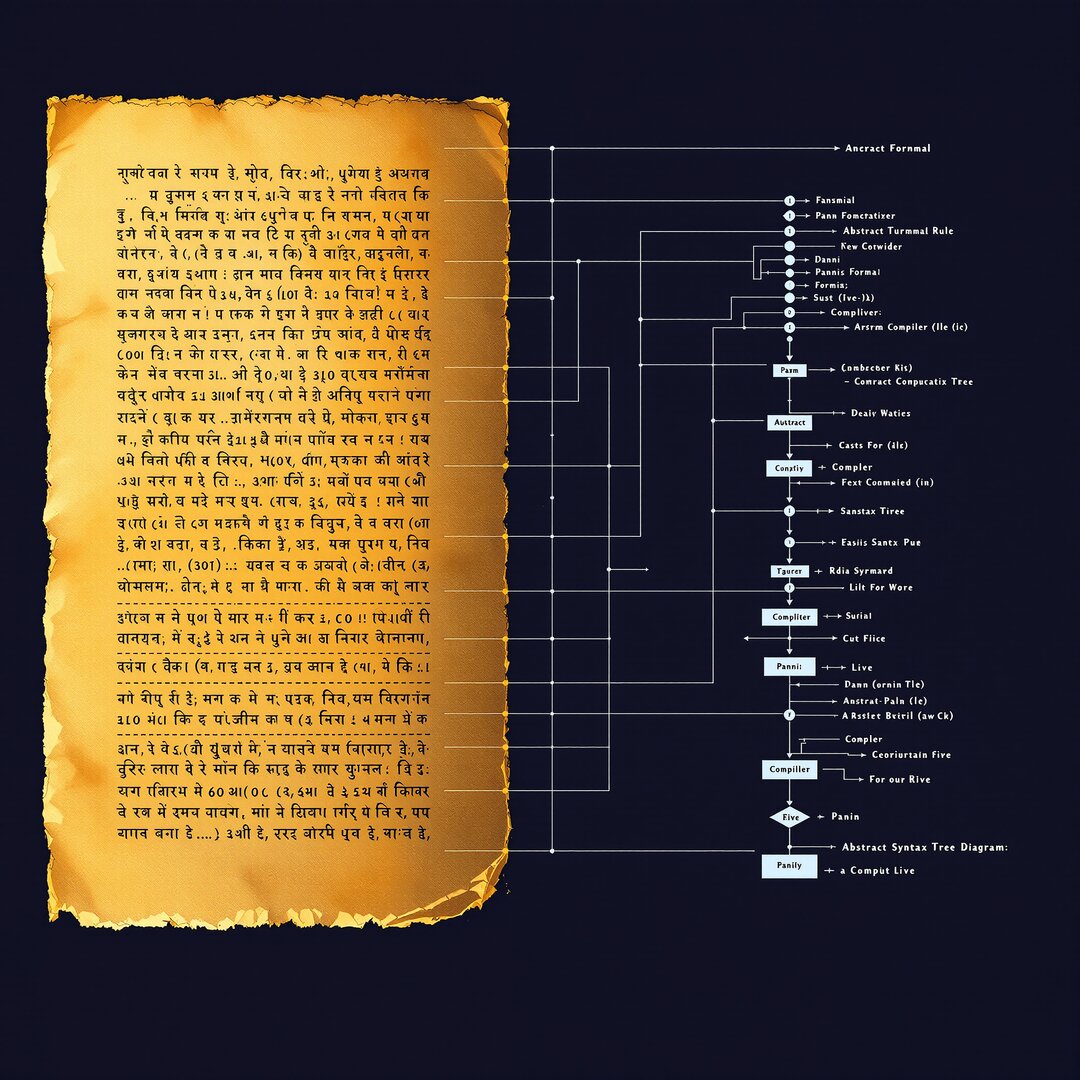
The Man Who Compiled a Language
Pāṇini (पाणिनि) lived in Gandhara (modern-day northwest Pakistan) around 400 BCE. He composed the Aṣṭādhyāyī (अष्टाध्यायी) — literally "Eight Chapters" — a treatise of exactly 3,959 rules (sūtra) that completely describe the Sanskrit language.
Not approximately. Not most of it. All of it.
Given any combination of roots, affixes, and contexts, the Ashtadhyayi can tell you: is this valid Sanskrit? If so, what does it mean? And if multiple interpretations are possible, which one takes precedence?
This is not a grammar textbook. Textbooks describe language by example. The Ashtadhyayi describes language by specification — a set of formal rules that can generate every valid expression and reject every invalid one. In modern terms: it's a compiler spec.
The Architecture रचना
Layer 1: The Phoneme Table — Maheshvara Sutras
Before you can write rules about sounds, you need a way to refer to groups of sounds. Panini's solution is the 14 Māheśvara Sūtras (also called Śiva Sūtras). These 14 short sequences arrange all 43 Sanskrit phonemes in a specific order, interspersed with 14 marker consonants (anubandha).
The genius: any natural class of phonemes — vowels, stops, nasals, voiced consonants, etc. — can be referenced by a two-letter code called a pratyāhāra. You take the first phoneme of the range and the marker at the end. This gives you 300+ distinct phoneme classes from just 14 short sutras.
This is a compression scheme. And it's more space-efficient than anything in Unicode.
The Shiva Sutras are to Panini's grammar what the ASCII table is to computing — the foundational encoding that everything else builds on. But whereas ASCII was designed by committee, the Shiva Sutras were designed by a single mind to optimize for the specific operations his grammar would need.
Layer 2: The Metalanguage
Panini writes his rules in an extremely compressed metalanguage of his own invention. Each sutra is a terse formula using technical terms (saṃjñā), operational rules (vidhi), and context indicators. The language of the rules is itself formally specified — there's a grammar of the grammar.
For example, the sutra 6.1.77: iko yaṇ aci means:
WHEN a phoneme from class iK (i, u, ṛ, ḷ)
BEFORE a phoneme from class aC (any vowel)
THEN replace with corresponding yaṆ (y, v, r, l)
if (current ∈ {i, u, ṛ, ḷ} && next ∈ vowels) {
replace(current, semivowel_of(current));
}
Every technical term in the sutra is defined elsewhere in the grammar. Every phoneme class is derivable from the Shiva Sutras. The whole system is self-contained — it bootstraps its own definitions. If that sounds like a programming language that defines its own standard library, that's because it is.
Layer 3: The Rule Engine
The 3,959 sutras are organized into 8 chapters (adhyāya), each with 4 sections (pāda). But the numbering isn't arbitrary — it encodes the scope of rules:
| Chapter |
Content |
Programming Equivalent |
| 1 |
Definitions and meta-rules (saṃjñā, paribhāṣā) |
Type definitions, compiler directives |
| 2 |
Noun compounds and case relations |
Data structures and composition |
| 3 |
Verbal affixes — tense, mood, voice |
Function signatures and modifiers |
| 4–5 |
Nominal affixes — derivation |
Type constructors and factories |
| 6–7 |
Phonological transformations (sandhi, accent) |
Compilation, linking, optimization |
| 8 |
Final phonological rules (applied last) |
Post-processing, output formatting |
Chapter 8 has a special property: its rules apply in a single, final pass — they cannot trigger earlier rules. This is the "output" phase. In compiler terms, chapters 1–7 are the front-end and middle-end (parsing, semantic analysis, optimization), and chapter 8 is the back-end (code generation). The architecture is literally a compilation pipeline.
Layer 4: Conflict Resolution
When multiple rules could apply to the same input, Panini's system uses a hierarchy of meta-principles to decide:
1. nitya — obligatory (rule MUST apply)
2. antaraṅga — inner scope (more local rule wins)
3. apavāda — exception (specific beats general)
4. para — later rule (position-based tiebreak)
1. !important — obligatory override
2. inline style — most local scope
3. #id > .class — specific beats general
4. source order — later declaration wins
The parallel with CSS specificity is not a stretch. Both systems solve the same problem: when you have hundreds of rules that might conflict, you need a deterministic, hierarchical resolution mechanism. Panini's is arguably more elegant because it distinguishes between scope (antaraṅga vs bahiraṅga, inner vs outer) and generality (apavāda vs utsarga, exception vs default) — two different axes of specificity that CSS collapses into one.
The Legacy परम्परा
Patanjali — The First Debugger
Around 200 BCE, Patañjali wrote the Mahābhāṣya — a massive commentary on the Ashtadhyayi that documents edge cases, resolves ambiguities, and identifies rules that interact in unexpected ways. This is, functionally, the first bug report and patch collection for a language specification. Every modern RFC and errata list descends from this tradition.
Backus and the BNF Connection
In 1959, John Backus introduced Backus-Naur Form to describe the syntax of ALGOL 60. BNF notation — with its production rules, non-terminals, and recursive definitions — is structurally similar to Panini's sutra format. The historical connection is debated: Backus likely developed BNF independently, but several linguists (notably Paul Kiparsky) have documented the striking formal parallels between the two notational systems.
What's not debated: Panini did it first, by 2,350 years.
Chomsky's Generative Grammar
Noam Chomsky's generative grammar (1956) posits that language can be described by a finite set of rules that generate an infinite set of valid sentences. This is exactly what the Ashtadhyayi does. Chomsky was aware of the Indian grammatical tradition — his doctoral advisor Zellig Harris had studied it — though the extent of direct influence is debated among scholars.
What's clear: the Indian grammatical tradition, beginning with Panini, represents the earliest known instance of the generative approach to language — the insight that a finite rule system can produce infinite output. This is the same insight that underpins every programming language ever built.
The Briggs Paper (1985)
Rick Briggs's 1985 paper in AI Magazine, "Knowledge Representation in Sanskrit and Artificial Intelligence," is frequently misquoted as claiming that "Sanskrit is the best language for AI" or that "NASA uses Sanskrit for programming." It says neither of these things.
What Briggs actually argued: Sanskrit's grammatical structure — specifically, its explicit encoding of semantic relationships through case endings and karaka theory — makes it a natural fit for knowledge representation systems. The grammar itself provides the kind of unambiguous semantic annotation that AI systems typically require as additional markup. This is a genuine and interesting observation. It's just not what the internet turned it into.
Why "Compiler"?
A compiler takes a high-level specification and transforms it, through a series of rule-governed passes, into a lower-level output. It resolves references, applies transformations, handles exceptions, and produces something that can actually be executed.
The Ashtadhyayi takes abstract roots and morphemes (high-level) and transforms them, through a series of rule-governed passes, into concrete spoken forms (low-level). It resolves phonetic references (sandhi), applies morphological transformations, handles exceptions (apavada), and produces something that can actually be spoken.
The word "compiler" fits because the architecture fits. Not as metaphor. As description.